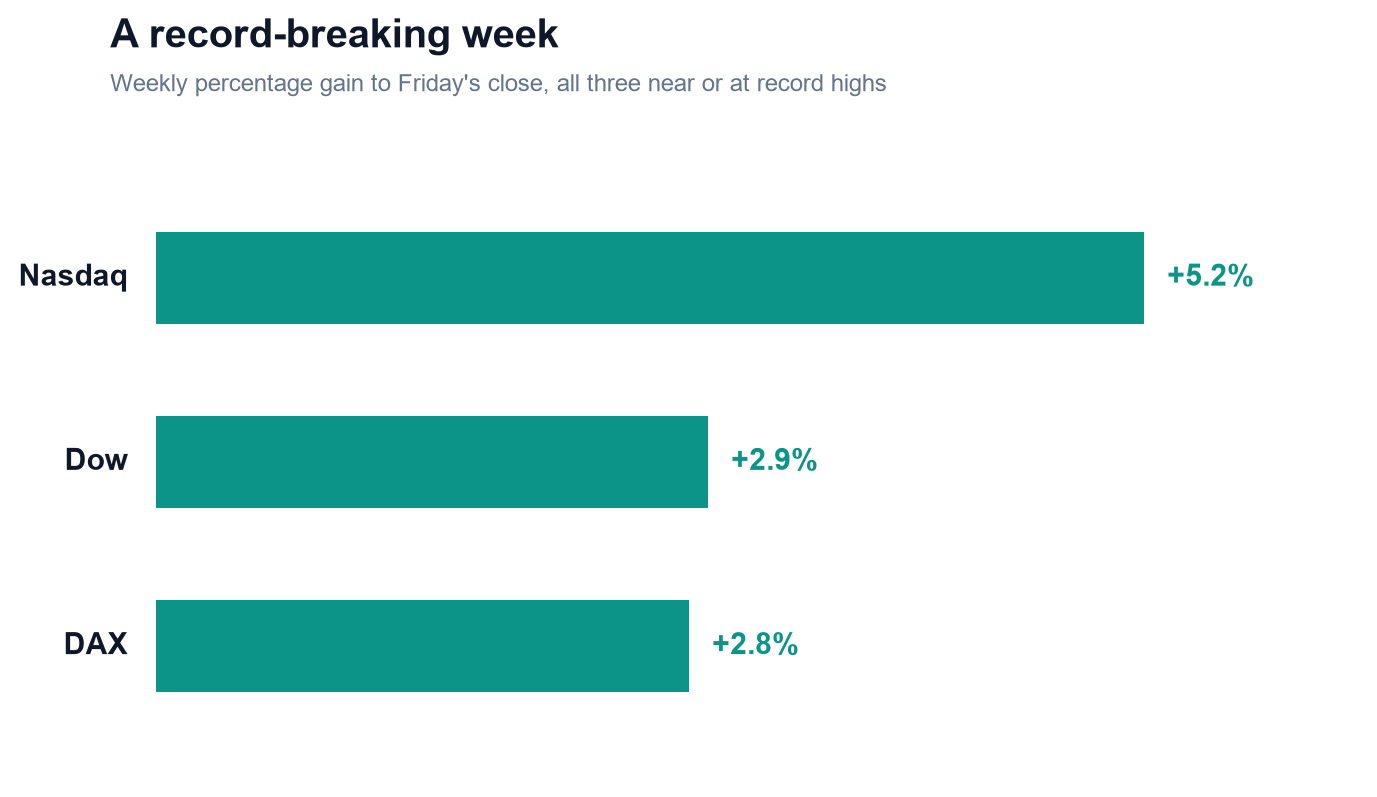
Last week gave the desks something to talk about. The DAX, Dow, and Nasdaq all closed near records on Friday, each riding its own version of the same story: an earnings season stronger than expected, and a labour market soft enough to put rate cuts back on the table. This week hands the wheel to a different driver. With earnings thinning out, US inflation data takes over as the thing that moves price.
In focus
DAX
The DAX put in its best week since April, up 2.8% to close Friday at 26,319, with SAP, Scout24, and Infineon leading a rally that had as much to do with Germany’s own numbers as with sentiment from abroad, industrial production and export data both came in ahead of forecast. Underneath that index-level strength, the earnings season leaves a messier picture. Siemens raised its full-year outlook and reported record orders and still sold off, Rheinmetall grew sales 39% and operating profit 74% yet cut its 2026 forecast after a cancelled frigate programme, and Munich Re and Allianz both posted solid profits while flagging softer insurance revenue ahead. Deutsche Telekom was the one clean win, rallying on an expanded share buyback. Monday’s open is quiet, sitting close to Friday’s high, so this week is really about whether that dispersion beneath the surface starts to matter once the earnings tailwind fades, leaving the index to trade off Wednesday and Thursday’s US inflation prints instead.
Dow
The Dow closed at 54,036.93 on Friday, a near-3% weekly gain and its strongest week since April, but Monday opened on the back foot, futures slipping as Brent crude pushed past $84 on renewed uncertainty over the Strait of Hormuz, with Iran and Oman reportedly closing in on a shipping-route agreement over the weekend. The bigger tension for the Dow this week sits in the rates market, not the oil market: CME’s FedWatch tool was still pricing better than 60% odds of a Fed hike at September’s meeting as of last week, even after a jobs report weak enough to help extend the index’s run of record closes, and three FOMC members already backed a hike in July. Wednesday’s CPI and Thursday’s PPI are what settle that argument. A soft print keeps the current “weak data, easier Fed” story intact and gives the Dow’s rate-sensitive financials and industrials room to keep climbing, a hot one hands the hike camp real ammunition and puts last week’s record squarely at risk, right as the Hormuz situation adds a second, harder-to-price source of pressure.
Nasdaq
The Nasdaq had the strongest week of the three, the Composite up 5.19% to 26,690.62 on a sharp bounce in semiconductor names, and futures were still climbing into Monday’s open, near 29,900 on the Nasdaq 100, even as the Dow slipped on oil. Two earnings this week test whether that bounce has real legs: CoreWeave reports Tuesday after the close, a direct read on whether AI infrastructure spending is running as hot as the rally assumes, and Applied Materials follows Thursday, a chip-equipment maker whose order book says more about actual semiconductor demand than any single momentum stock can. Nasdaq is also the most exposed of the three to Wednesday and Thursday’s inflation prints, long-duration growth names take the hardest hit if the Fed’s hike odds firm up, so a hot CPI print would challenge this rally from two directions at once.
Elsewhere this week
The S&P 500 matched the mood, a record close at 7,757.64 on Friday and its best week since April, helped along by the same soft jobs report that lifted the other two. UK100 held a tighter range, closing at 10,901 on defensive strength rather than a clear breakout, and has no major domestic data of its own this week either. Gold had the loudest week of the lot, up 7.2% after six weeks of consolidation, and is holding a tight 4,300 to 4,350 band into Monday, if that support at 4,300 gives way, the breakout story gets a lot less convincing. EURUSD sits around 1.156, with the ECB parked until its September meeting, so its direction this week is really a US-data story, CPI and PPI will do more to move it than anything happening in Europe.
The calendar
Wednesday brings US CPI for July, Thursday brings PPI, and Friday closes the week with retail sales and the preliminary University of Michigan sentiment read. All three land against a market already leaning toward a softer Fed after last month’s weak payrolls print, so hotter-than-expected inflation is the scenario most likely to unwind some of last week’s gains. Layer the Hormuz situation on top and it’s a week where the calendar and the geopolitics could easily pull in opposite directions.
Nothing on this page is financial advice. Levels and views here are a starting point for your own analysis, not a signal to trade.