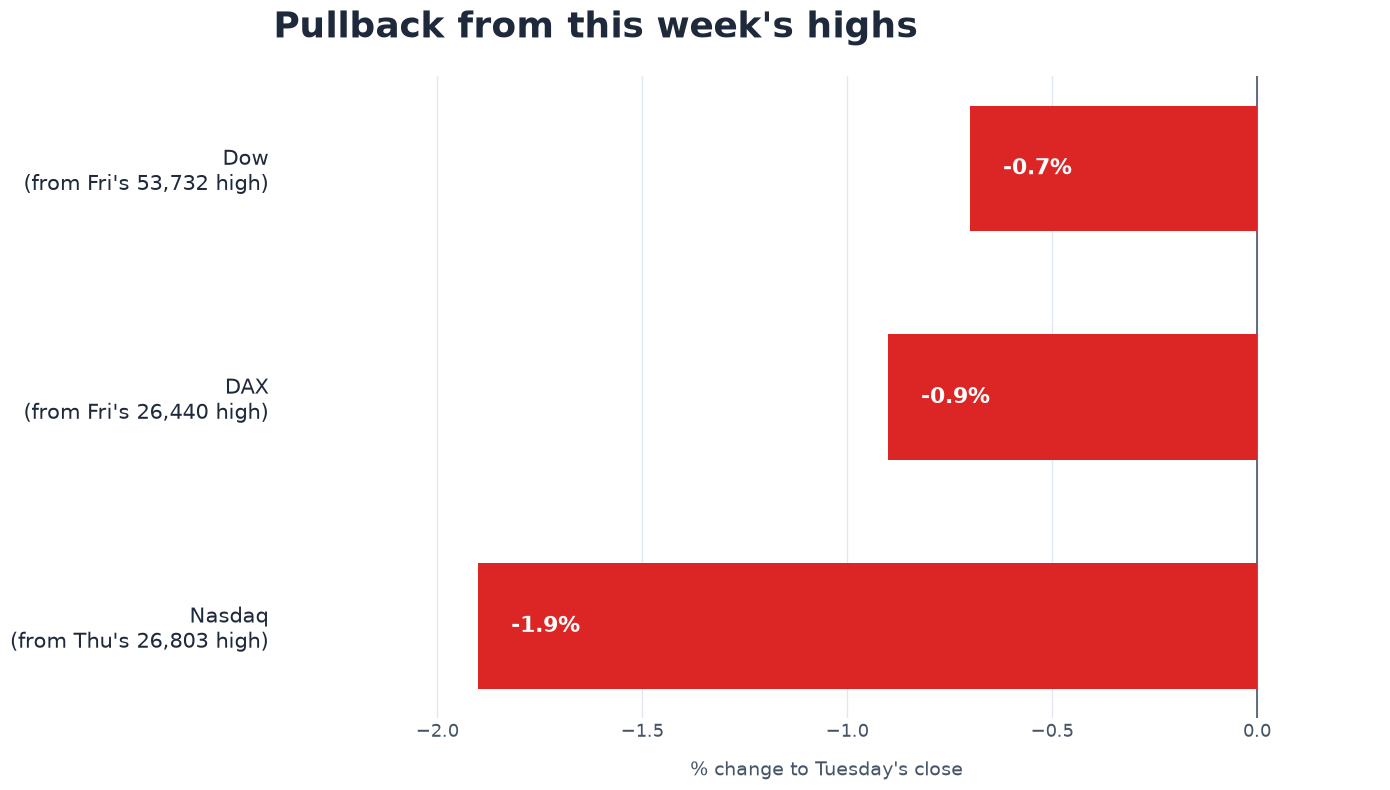
This one’s going out two days later than planned, picking up mid-week instead of at the start of it. Last week ended with records: the S&P 500 broke 7,800 on Thursday, the DAX brushed its own all-time high on Friday, and the Nasdaq Composite put in its best single session in weeks. The two sessions since have undone a good part of that. Long-dated Treasury yields have spiked to levels not seen since 2007, oil has jumped as US-Iran talks over the Strait of Hormuz broke down, and all three indices have now fallen for two straight days. Today’s FOMC minutes and a wave of retail earnings, several of them out this morning, are what decide whether that continues.
In focus
DAX
The DAX came within a hair of an all-time high on Friday, closing at a record 26,440, then gave most of it back: down 0.4% Monday to 26,339 and another 0.4% Tuesday to around 26,200, its lowest close since August 6. The pullback wasn’t broad, Infineon (-2.5%) and Siemens Energy (-2.2%) led the losers as the same rate story hitting US chip names weighed on Germany’s own tech and industrial names, while Deutsche Post and Deutsche Telekom both held up with gains near 0.9%. There’s no major German data due this week, so the index is really trading on the same global inputs as everyone else: today’s FOMC minutes for the rates side, and Friday’s flash eurozone PMI for the growth side, which matters more than usual after July’s composite reading jumped to 51.9, its first real expansion in four months. A soft PMI on top of a hawkish-leaning Fed would leave the DAX with nothing to lean on going into next week.
Dow
The Dow never quite matched the S&P’s record run, slipping 0.2% on Friday to 53,732 even as the broader market hit new highs, then extended that into a third straight losing session Tuesday, down 0.22% to 53,343. The driver is the bond market: the 30-year Treasury yield broke above 5.3% this week, its highest since 2007, as fading hopes for a Hormuz shipping deal pushed Brent crude toward $88 and dragged yields up with it. Today’s FOMC minutes from the July 28-29 meeting are the week’s central event because of it. That meeting split 9-3, with Cleveland’s Beth Hammack, Minneapolis’s Neel Kashkari, and Dallas’s Lorie Logan all dissenting in favour of a hike over persistent inflation, the largest hawkish dissent since 2016, and the minutes will show how close the rest of the committee came to joining them. Retail earnings run alongside it: Home Depot’s Tuesday report beat estimates with its best US comparable-sales growth since late 2022, Target and Lowe’s report this morning, and Walmart closes the week Thursday with the Street looking for $0.74 EPS on $186.9 billion in revenue, days after July retail sales posted their weakest month since May 2025. A hawkish set of minutes paired with a cautious Walmart would hit the Dow from both the rates side and the consumer side in the same week.
Nasdaq
The Composite’s own record run ended just as fast as it started. Thursday’s 26,803 close, up 0.81% on a soft inflation print, gave way to a 1.33% drop Tuesday to 26,289, its worst single session in weeks, led by chip names rather than the broader tech complex. Nvidia fell more than 2%, Micron dropped almost 6%, and Broadcom lost over 3%, with the Philadelphia Semiconductor Index down close to 4% on the day. The mechanism is the same yield spike hitting the Dow, just amplified: long-duration growth stocks lose more value than anything else when the discount rate on their future earnings rises this fast, and a financing environment with the 30-year above 5.3% makes the AI infrastructure buildout the whole sector is pricing in noticeably more expensive. Analog Devices reports this morning before the open, with the Street expecting $3.33 EPS on $3.93 billion revenue against a strong prior quarter. A solid number from an analog and mixed-signal chipmaker, not another AI-accelerator name riding the Nvidia trade, would say something more grounded about underlying semiconductor demand than the momentum names can, and Friday’s flash US PMI closes the week with the first real read on whether August activity is holding up the way July’s did.
Elsewhere this week
The S&P 500 fell 0.5% Tuesday, pulling back from Thursday’s 7,798.99 record but still comfortably higher on the month. UK100 was one of the few indices in the green, up slightly as its heavy weighting to oil majors gave it a direct hedge against the same crude spike that’s hurting everything else. Gold told the more surprising story: down 1.2% to around $4,360, erasing two sessions of gains despite the Hormuz tension, because rising real yields are outweighing the usual safe-haven bid for now. EURUSD sits flat near 1.157, parked ahead of today’s minutes and Friday’s PMI prints, with little reason to move on its own this week.
The calendar
Today is the week’s hinge: FOMC minutes at 2pm ET, plus premarket earnings already out this morning from Target, Lowe’s, TJX, and Analog Devices. Thursday brings Walmart before the open and weekly jobless claims. Friday closes things out with the flash S&P Global PMIs for the US and eurozone. With Jackson Hole still over a week away (August 27-29), today’s minutes are the nearest thing markets have to a steer on where the hawkish dissent inside the Fed is heading, and this week’s retail earnings add a second, independent read on whether the consumer can absorb it.
Nothing on this page is financial advice. Levels and views here are a starting point for your own analysis, not a signal to trade.